
Dr Reddy's Laboratories on Friday soft-launched imported COVID-19 vaccine Sputnik V, with Deepak Sapra, a senior executive of the drug-maker, taking the first shot in Hyderabad.

The bench, which was critical of the Centre's stand on the issue, said "You (government) are so short of vaccines and you are not taking it through. May be it is an opportunity for you. Don't be so negative. It is like a raging fire and nobody is bothered. You people don't understand the larger picture or what.

As the Omicron variant of Sars-CoV-2 takes centrestage, vaccine makers in India are of the view that scaling up the existing vaccines to make them more effective is possible.

Even as the inoculation drive against COVID-19 is set to start in two days, a Maharashtra government official said on Thursday that it will take six to seven months for the vaccine to become available for those who are not in the high-risk category.
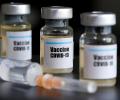
The procurement and distribution will be centralised though the government is yet to take a call on the initial number of doses that will be procured.
Phase-I clinical trials have revealed "excellent safety" of the two candidate vaccines indigenously developed by Bharat Biotech in collaboration with Indian Council of Medical Research and Cadila Healthcare Ltd and their immunogenicity testing is now in progress, minister of state for health Ashwini Choubey informed the Rajya Sabha on Tuesday.
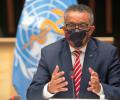
Prime Minister Modi has said India's vaccine production and delivery capacity will be used for the benefit of all humanity to fight the COVID-19 pandemic. He said last week India was ready to do everything possible for a healthy planet.
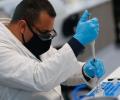
The Centre has also contacted five domestic and three multinational vaccine makers to understand how soon a candidate vaccine against Covid-19 will be ready.

The official expressed hope on the success of the five vaccines that are under different phases of trial in the country.

According to sources, around 10 crore doses of the Sputnik V vaccine is likely to be imported for emergency use in the country in the next six to seven months.
While the vaccine could be available at $3-6 (Rs 225 to Rs 550) per dose, herd immunity might be two years away due to implementation challenges, it said, adding the experience in large scale adult vaccination programmes is thin.
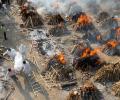
A second wave of Covid driven by the Delta variant engulfed the country in May-June bringing the health system to its knees and leaving people gasping for help.
The novel mRNA vaccine candidate, HGCO19, is supported with seed grant under the Ind-CEPI mission of the Department of Biotechnology. The mRNA vaccines do not use the conventional model to produce immune response. Instead, they carry molecular instructions to make the protein in the body through a synthetic RNA of the virus.

'What the government should do is to use the vaccine judiciously, not just to prevent a third wave alone, but to stop the number of deaths happening in the interim.'

Replying to a short duration discussion on COVID-19 management in Rajya Sabha, the minister said technology transfer to several companies has started and they will begin production in the coming days to reduce vaccine shortage in the country.

PM Modi said that it was an honour to be a trusted partner during the pandemic adding that the two countries will continue to strengthen cooperation on healthcare.

Amid reports of the ongoing coal shortage in the country, Finance Minister Nirmala Sitharaman stressed that there is no shortage and termed these as "absolutely baseless", saying India is a power surplus country. Sitharaman said that Power Minister R K Singh went on record just two days ago when he said absolutely baseless information is floating around that there is probably shortage of coal, shortage of other inventories which will lead to a sudden gap in the supply demand situation in the energy consumption. "Absolute baseless! There is no shortage of anything. In fact, if I recall the minister's statement, every power producing installation has the next four days' stock absolutely available within their own premises and the supply chain has not broken at all," Sitharaman said at Harvard Kennedy School on Tuesday.

Health Minister Harsh Vardhan said the COVID-19 vaccine will be available in the next few months and it is estimated that by July-August 400-500 million doses will be made available for 25-30 crore people.

The SC said journalists' work can be done without coming in contact with people unlike lawyers and asked the Centre to consider the legal fraternity's request for priority in COVID-19 vaccination saying their livelihood depends on direct interaction with their clients.
At $37 per dose, the Pfizer vaccine is much more expensive compared to $3 per dose for the Covishield.
'Antibodies remain in the blood for at least seven to nine months.'
In a report submitted Monday to Rajya Sabha chairman and Vice President M Venkaiah Naidu, the Parliamentary Standing Committee on Home Affairs also said there was a need for a comprehensive public health law to keep a tab on private hospitals and check black-marketing of medicines.

Health practitioners who have been vaccinated against coronavirus or have administered the shots to others took part, sharing their first-hand experiences.
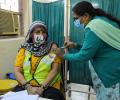
Anybody over 50 years of age or with co-morbidities can get a date, place and time of choice for getting the vaccine shots.
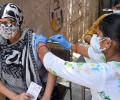
India expects 2.16 billion doses of Covid-19 vaccines between August and December, including the jabs that are currently in clinical trials, reports Sohini Das

A total of 3,006 session sites across all states and union territories will be virtually connected during the launch at 10.30 am by Prime Minister Narendra Modi and around 100 beneficiaries will be vaccinated at each session site.

The announcement comes a day after the Subject Expert Committee (SEC) on COVID-19 of the CDSCO recommended granting emergency use authorisation (EUA) to the COVID-19 vaccines Covovax and Corbevax with certain conditions.

In a video issued by the Health Ministry, Dr Randeep Guleria, Director of the All India Institute of Medical Sciences (AIIMS) answered commonly asked questions regarding the dosage of the vaccine saying that two doses of the vaccine will have to be taken 28 days apart and protective levels of antibodies generally would develop two weeks after the second dose.

The Central Drugs Standard Control Organisation has granted restricted emergency use authorisation to two new vaccines and a drug for COVID-19, taking the number of preventives and treatments available in India to 12.

More than 2 million people have been diagnosed with coronavirus across the world, and the pharmaceutical industry is pulling out all stops to find potential treatments and vaccines for the global pandemic. According to the World Health Organization, there are now more than 70 potential vaccines under evelopment, with some already in clinical trials.
A 40-year-old man who was a volunteer in the third phase of the ''Covidshield'' vaccine trial in Chennai has alleged serious side effects, including a virtual neurological breakdown and impairment of cognitive functions.
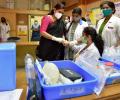
"The Indian Medical Association has requested all its 3.5 lakh members in 1,800 local branches to voluntarily come out to get vaccinated first to show the world that these vaccines are safe and efficacious," it said.

In a tweet, Prime Minister Narendra Modi said India is deeply honoured to be a 'long-trusted' partner in meeting the healthcare needs of the global community and that supplies of the vaccines to several countries will commence on Wednesday, and more will follow in the days ahead.
British nationals arriving in India, irrespective of their vaccination status, will have to undergo 10 days of mandatory quarantine from October 4 as part of the reciprocal actions initiated by the government following the vaccine certification row between the two countries.

For vaccination, online registration is mandatory. Thereafter, eligible beneficiaries will be informed on their registered mobile number about the nearest vaccination facility, and the date and time of vaccination.

The EC said that the data should be deleted by health authorities once the vaccination exercise concludes.

Laws governing compensation in case of adverse side effects for Covaxin and Covishield may differ in accordance with the kind of approvals given, say legal experts.
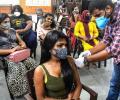
They said 37.5 crore of Covishield doses from the Serum Institute of India and 28.5 crore Covaxin doses from Bharat Biotech will be procured by December.
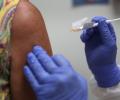
Vaccinating all citizens above the age of 18 years against COVID-19 will cost Rs 67,193 crore, of which states together will incur Rs 46,323 crore, India Ratings and Research (Ind-Ra) said on Thursday. As the second wave of COVID-19 sweeps the country with alarming speed and severity, the government has announced a liberalised and accelerated Phase 3 strategy of COVID-19 vaccination. Under this scheme, all persons above 18 years of age will be eligible to get COVID-19 vaccine doses from May 1.

'Prevention plus vaccination is what is going to take us into better territory by September or October.'
 © 2026 Rediff.com - Advertise with us - Disclaimer - Privacy Policy - Sitemap - Feedback - About us - Terms of use - Grievances